Bresnick, M.: Bitter Suite, Duo for Violin and Piano (violin and piano) CF
This work for violin and piano by Martin Bresnick is a play on the words "suite" and "bittersweet." Each of the four movements is based on a Yiddish folk song, which in English translate to On the Road, My Resting Place, Black Cat, and Dona, Dona. Each of the four pieces is primarily based on a Jewish folk song, but re-envisions them in a modern context, akin to Bartok and Kodaly. The composer noted, “I found it a very challenging, yet touching way to remain in contact with some part of my own past that I don’t usually reveal.” The title references the difficult (bitter) and pleasant (sweet) aspects of experiencing the tumultuous history of a people through their folk music.
Product Information
Product Information
Shipping & Returns
Shipping & Returns
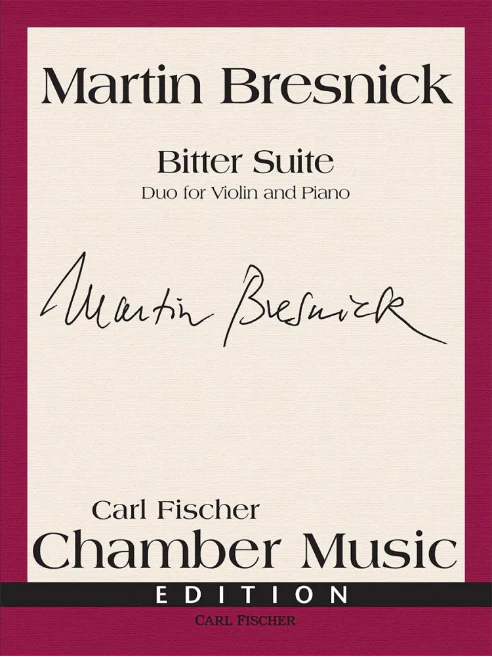
Bresnick, M.: Bitter Suite, Duo for Violin and Piano (violin and piano) CF
Bresnick, M.: Bitter Suite, Duo for Violin and Piano (violin and piano) CF
This work for violin and piano by Martin Bresnick is a play on the words "suite" and "bittersweet." Each of the four movements is based on a Yiddish folk song, which in English translate to On the Road, My Resting Place, Black Cat, and Dona, Dona. Each of the four pieces is primarily based on a Jewish folk song, but re-envisions them in a modern context, akin to Bartok and Kodaly. The composer noted, “I found it a very challenging, yet touching way to remain in contact with some part of my own past that I don’t usually reveal.” The title references the difficult (bitter) and pleasant (sweet) aspects of experiencing the tumultuous history of a people through their folk music.
Product Information
Product Information
Shipping & Returns
Shipping & Returns
Description
This work for violin and piano by Martin Bresnick is a play on the words "suite" and "bittersweet." Each of the four movements is based on a Yiddish folk song, which in English translate to On the Road, My Resting Place, Black Cat, and Dona, Dona. Each of the four pieces is primarily based on a Jewish folk song, but re-envisions them in a modern context, akin to Bartok and Kodaly. The composer noted, “I found it a very challenging, yet touching way to remain in contact with some part of my own past that I don’t usually reveal.” The title references the difficult (bitter) and pleasant (sweet) aspects of experiencing the tumultuous history of a people through their folk music.